
With global certainties rising post 2020 and industries struggling to prevent supply chain disruptions, more businesses are looking to leverage AI in supply chain management and logistics optimization.
AI in business operations in 2026 is no longer a brainer. Here are some quick challenges that businesses around the world are facing right now.
- The fertilizer supply chain issues can currently trigger a massive food crisis globally.
- Supply for laptops, servers, and networking gear is under immense pressure, so much so that companies are resorting to dual sourcing to ensure that they get material or component supply from at least one source. Even companies like Apple are having to resort to dual sourcing to ensure the availability of their products.
- Similarly, the global economic and war situation seems to be leading us towards pharmaceutical shortages.
Businesses, industries, and traditional supply chain models are currently being tested.
For decades, global supply chains operated on the principles of lean manufacturing and just-in-time (JIT) delivery, prioritizing maximum efficiency and minimum waste.
While this model provided unwavering reliability in predictable environments, recent global disruptions have exposed a fundamental flaw: traditional supply chain models were never designed to handle extreme volatility.
Today, supply chain management is transitioning from a “hidden engine” that only gains attention during failure to a proactive, tech-intensive driver of global commerce. Custom-made Artificial Intelligence development solutions are the major catalyst for this shift.
In this in-depth enterprise AI guide, we will be discussing what is role of AI, Agentic AI, use cases, examples, and what are the various ways you can use AI in supply chain management.
How Does AI in Supply Chain Management Work?
The modern companies have embraced the “Supply Chain Trifecta,” which integrates Cloud Architecture, Data, and AI into a single heterogeneous solution.
When we talk about AI in supply chain, we are often referring to a broad set of technologies: machine learning, predictive analytics, natural language processing, generative AI, computer vision solutions, and automation. These tools work together to turn raw operational data into decisions.
The Technical Architecture of Flow
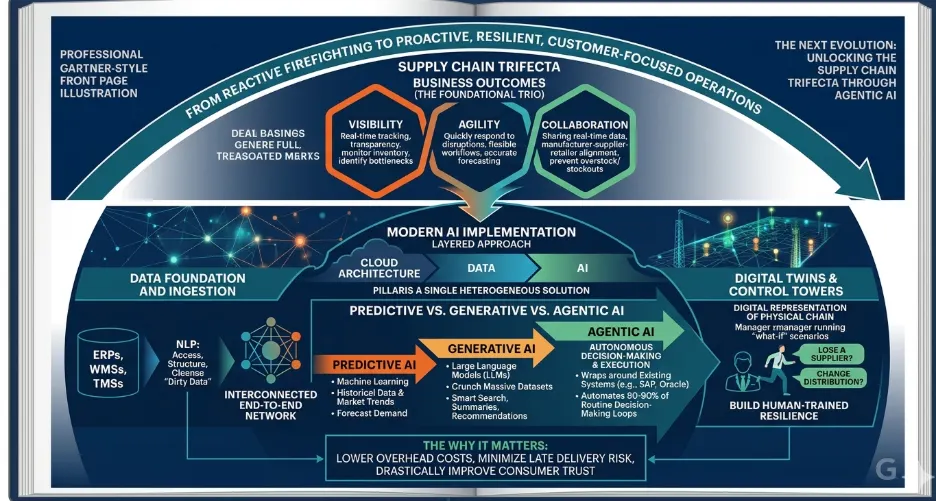
According to our expert AI developers, modern agentic AI systems in supply chain management work to keep your business running smoothly and avoid major disruptions.
- Data Foundation and Ingestion: Our experts integrate AI in Supply chain management by connecting data from ERPs, WMSs, and TMSs. AI uses Natural Language Processing (NLP) to access, structure, and cleanse “dirty data” trapped in functional silos, creating an interconnected end-to-end network which makes data analytics and visualization simple.
- Predictive vs. Generative vs. Agentic AI: One of the major misconceptions, according to us, is thinking that AI, Agentic AI, and Generative AI in the Supply chain can’t exist in parallel.
So, your AI tool for supply chain should not fight or take predictive AI vs generative AI vs. Agentic AI approach, but instead be made of all three technology.
- Predictive AI leverages machine learning algorithms to analyze historical data and market trends to forecast demand fluctuations and potential disruptions.
- Custom-made generative AI solution utilizes Large Language Models (LLMs) to crunch massive datasets, providing smart search results, summaries, and recommendations that go beyond traditional analytics.
- Next involves developing an Agentic AI solution that shifts business from being reactive to proactive. Unlike previous iterations, Agentic AI can autonomously make decisions and execute tasks by wrapping around existing systems (like SAP or Oracle) to automate 80-90% of routine decision-making loops.
- Digital Twins and Control Towers: These platforms create a digital representation of the physical supply chain, allowing managers to run “what-if” scenarios (e.g., losing a supplier or changing distribution patterns) to build human-trained resilience. For example, while a control tower may detect that a storm could delay shipments in a region, the digital twin can instantly simulate alternative routes, evaluate inventory availability, and recommend the most cost-effective response.
The goal is not to replace human decision-making, but to enhance it with faster and more actionable insights. Instead of manually analyzing spreadsheets for hours, AI systems can proactively alert managers with insights.
Use of AI in Supply Chain Management
AI’s impact on supply chain optimization isn’t uniform; it compounds across every layer of the operation. The implementations we’ve seen deliver the most value follow the SCOR model (Plan, Source, Make, Deliver, Return), deploying targeted AI capabilities at each stage rather than treating it as a single monolithic solution.
Demand Forecasting – Beyond Historical Patterns
Traditional forecasting was always fighting the last war. It extrapolated from historical sales data, which works reasonably well in stable markets and fails catastrophically when conditions shift. The ML-based forecasting systems we build ingest dozens of concurrent variables, social sentiment, local economic indicators, competitor pricing, weather anomalies, and macroeconomic signals, and weight them dynamically against each other.
The practical result: retailers and manufacturers we’ve worked with report meaningful reductions in both stockouts and overstock situations, with direct margin impact. More importantly, the model improves continuously as it processes new data, something no static forecasting spreadsheet can ever do.
Inventory Management – Precision Over Padding
For decades, safety stock was the industry’s answer to uncertainty: carry more than you need and hope for the best. The AI-powered inventory systems we develop make that approach obsolete. By integrating IoT sensors that monitor stock levels in real-time, across warehouses, distribution centers, and retail floors, the system continuously recalibrates reorder points against live demand signals rather than lagged reports.
Pair that with automated warehouse robots like Amazon’s Kiva or FedEx’s Dora, which our teams have worked with extensively, and you’re looking at picking and sorting operations that are faster, more accurate, and dramatically less labor-intensive.
The guesswork that used to drive bloated working capital or costly stockouts gets engineered out of the system entirely. This is especially critical for businesses managing seasonal spikes or complex, multi-SKU portfolios where manual tracking simply breaks down.
Predictive Equipment Maintenance – Eliminating the Unplanned
A conveyor failure in a fulfillment center doesn’t stay contained, it cascades. The predictive maintenance architectures we’ve deployed continuously monitor equipment sensor data, identifying early degradation signatures well before a breakdown occurs. That converts reactive, expensive emergency repairs into scheduled, low-disruption maintenance windows that operations teams can plan around. Clients who’ve moved to this model consistently report significant reductions in unplanned downtime, and the emergency repair costs that used to quietly drain budgets disappear almost entirely once the system is running.
Logistics and Route Optimization – Dynamic, Not Static
Route optimization used to mean finding the shortest path. That’s a solved problem. The real complexity is dynamic, real-time traffic, fluctuating fuel costs, narrow delivery windows, vehicle load constraints, and live weather conditions all shift throughout the day. Our AI for supply chain solution recalculates continuously, rerouting in real time rather than locking in a plan at dispatch.
The compounding benefits, lower fuel burn, fewer delays, higher on-time delivery rates, become structural cost advantages at scale. One of our clients reduced last-mile delivery costs by double digits within the first two quarters of deployment.
Supplier Risk Management – Early Warning, Not Post-Mortem
Supply chains break at their weakest link, and that link is often invisible until it snaps. The supplier intelligence systems we’ve built change the posture from reactive to anticipatory, continuously monitoring delivery reliability, quality consistency, financial health signals, and geopolitical exposure across supplier networks. When a risk indicator surfaces, a supplier’s credit position deteriorating, a port slowdown in a key sourcing region, procurement teams receive early enough warning to activate contingency sources or adjust order volumes before the disruption lands. This capability has gone from a competitive differentiator to a baseline requirement since the early 2020s exposed just how fragile lean, single-source models actually were.
Warehouse Automation and Robotics – Coordinated Intelligence
The robots getting press coverage are only part of the story. Systems like Amazon’s Kiva and FedEx’s Dora are impressive in isolation, but the compounding value comes from AI coordinating these assets as a unified, continuously learning operation. The warehouse automation solutions we develop cover picking, packing, inventory counting, and dock scheduling simultaneously, not in silos. Critically, they integrate with existing Warehouse Management Systems rather than replacing them, which is precisely where most failed rollouts we’ve seen went wrong. The transition has to be additive, not disruptive.
Procurement Intelligence – Negotiating with Data
Procurement without comprehensive market intelligence is structurally disadvantaged. The procurement AI tools we’ve built give teams granular visibility into historical pricing trends, supplier behavior patterns, real-time market benchmarks, and contract term comparisons, turning negotiation from an art into a data-informed discipline. We’ve even implemented AI-driven chatbots that handle routine contract negotiations autonomously, freeing senior procurement staff to focus on strategic relationships. The outcome goes beyond cost savings: it builds supplier relationships grounded in transparency rather than positional bargaining.
End-to-End Visibility – The Real Control Tower
One of supply chain management’s most persistent failures has been the inability to see across tiers. Tier-1 suppliers are visible; what’s happening at Tier-2 and Tier-3 largely isn’t, until it becomes a crisis. The control tower solutions we architect consolidate fragmented data from ERPs, logistics providers, ports, and distribution centers into a unified real-time view of inventory position, shipment status, and emerging bottlenecks. The operational shift this enables is fundamental: response time to disruptions drops from days to hours, and in many cases, minutes.
Regulatory and Sustainability Compliance – Automated, Not Audited
Manually tracking carbon emissions, resource consumption, and waste generation across a multi-tier global supply chain is operationally impossible at the level of granularity that modern ESG reporting now demands. The compliance monitoring systems we build track these metrics automatically, flagging regulatory risks before they escalate into exposure. As sustainability disclosure requirements tighten across the EU, US, and Asian markets, this isn’t optional, it’s an operational necessity we’re helping clients get ahead of now.
Scalable Cloud Infrastructure – Enterprise AI Without Enterprise Price Tags
Supply chain data volumes are large and growing non-linearly. The architecture decisions made early determine whether the system scales gracefully or becomes a bottleneck. The cloud-native AI infrastructure we design handles fluctuating data loads dynamically, eliminating the capital expenditure of on-premise hardware that historically made enterprise-grade supply chain intelligence a large-company advantage. That barrier is effectively gone. Mid-sized businesses we work with are now running the same analytical horsepower that was previously reserved for companies with nine-figure IT budgets.
Real-Life Examples of Generative AI In Supply Chain
Walmart: Demand and Inventory Optimization
Walmart utilizes AI-powered predictive analytics to process vast datasets, including local market trends and customer purchasing habits. This allows for Smart Reallocation, where the AI engine automatically redistributes stock across hundreds of stores to balance inventory with predicted demand, significantly reducing waste and improving operational efficiency.
DHL: Dynamic Routing and Last-Mile Logistics
Last-mile delivery can account for up to 50% of total logistics costs. DHL employs AI in supply chain management to analyze real-time traffic and weather patterns, dynamically adjusting delivery schedules and routes. This ensures that drivers use the most efficient paths, which enhances customer satisfaction and reduces fuel consumption.
Real Life Examples of Agentic AI in Supply Chain
PepsiCo (Frito-Lay): Implemented the AutoScheduler AI (a warehouse agent) for decision-making enablement at manufacturing facilities. This led to an average 10%+ increase in productivity and throughput, with on-time in-full (OTIF) service levels skyrocketing to over 99%.
The Future: Inter-Agent Communication
The next three to five years will see a shift toward inter-agent communication, where a transportation agent and a warehouse agent communicate autonomously to resolve delays without human intervention. Eventually, the industry may return to a more advanced “Control Tower” concept, one “agent to rule them all”, that orchestrates the entire network in real-time.
Challenges of Implementing AI in Supply Chain Management
The ROI case for AI in supply chain is compelling. The implementation reality is harder. Having worked across dozens of supply chain AI deployments, here are the obstacles that consistently determine whether a rollout succeeds or stalls.
Change Management: The Hurdle No One Budgets For
Technology is rarely the reason AI implementations fail. People are. Supply chain personnel who have spent years mastering manual processes and firefighting disruptions don’t automatically trust a system telling them what to do next. The shift from reactive decision-making to AI-guided operations requires deliberate organizational change management, clear communication about what the AI is actually doing, why it’s being introduced, and critically, what it means for existing roles. Organizations that skip this step find that adoption rates crater regardless of how good the technology is.
Data Quality: Garbage In, Garbage Out
This one is non-negotiable. AI systems don’t compensate for bad data, they amplify it. Inaccurate inventory records, fragmented data trapped across incompatible ERPs and WMS platforms, and inconsistent supplier data don’t just limit AI performance; they produce confidently wrong recommendations that can cause real operational damage. Before any AI deployment we undertake, data governance and cleansing comes first. It’s not optional groundwork, it’s the foundation everything else is built on.
Legacy System Integration: The Silent Project Killer
Most enterprises didn’t build their supply chain infrastructure with the future AI integration challenges in mind. Connecting modern agentic AI systems to legacy ERPs and SCM platforms requires careful architectural planning and, in many cases, a phased migration approach rather than a hard cutover. The integrations we’ve built between AI layers and systems like SAP and Oracle are some of the most technically demanding work in any engagement, and underestimating this complexity is one of the most common reasons projects run over time and over budget.
High Initial Investment: And Where It Actually Goes
The software cost is visible. What organizations routinely underestimate is the full cost picture: data infrastructure work, integration engineering, internal capability building, and the ongoing need for AI specialists who can maintain and evolve the system. Companies that approach AI adoption purely as a software procurement decision consistently struggle. Those that treat it as an infrastructure investment, with the team and governance structure to match, see compounding returns.
Ethical AI and Regulatory Compliance
As AI takes on decision-making authority in procurement, logistics, and supplier management, regulatory scrutiny is tightening. Autonomous systems operating across international trade environments need to be transparent, auditable, and continuously monitored for compliance drift. This isn’t a legal checkbox, it’s an operational requirement that needs to be designed into the system architecture from day one, not retrofitted later.
Keeping Humans in the Loop: By Design
AI lacks the tribal knowledge that experienced supply chain professionals carry: the nuances of specific supplier relationships, the context behind historical anomalies, the judgment calls that don’t exist in any dataset. The systems we build are designed to augment that expertise, not replace it. Domain experts define the rules. AI executes within them, surfaces insights, and handles the volume of routine decisions that would otherwise consume human attention. The goal is always faster, better-informed human decisions, not removing humans from the equation.
Best Practices for Adopting AI Tools for Supply Chain Management
The organizations that get the most out of AI in supply chain share a consistent set of habits. These aren’t theoretical, they’re the practices we’ve seen separate successful implementations from expensive lessons.
Start with clean data, not AI tools: Establish data governance policies before evaluating any platform. The temptation to start with the technology and fix the data later is understandable and almost always costly. Accurate, well-organized, accessible data is the infrastructure on which every AI capability is built.
Choose problems, not technology: Identify the two or three supply chain challenges that are bleeding the most money or creating the most operational pain right now. Then find AI that solves those specific problems. Implementations that start with “we want to use AI” and work backward to the use case rarely produce meaningful ROI.
Build internal capability: Whether you partner with an AI development team or build in-house, you need people inside your organization who understand what the system is doing and can interpret its outputs critically. AI tools without internal champions become black boxes that get abandoned when something unexpected happens.
Invest in change management as seriously as the technology: Adoption fails when frontline staff don’t trust or understand what they’re being asked to use. Communicate the benefits clearly, involve operational teams in the rollout, and build feedback mechanisms that allow the system to improve based on real-world use. The rollouts we’ve seen succeed always had strong internal champions at the operational level, not just at the executive level.
Measure outcomes, not activity. Define success metrics before the first line of code is written. Forecast accuracy improvement, stockout reduction, transportation cost per unit, supplier on-time delivery rate, these are the numbers that matter. If you can’t measure it, you can’t improve it, and you can’t justify the next phase of investment.
Steps to Integrate AI in Supply Chain Optimization
There’s no universal implementation playbook, supply chains are too different from one another. But there is a consistent process framework that applies regardless of industry or scale.
Step 1: Audit Your Existing Supply Chain Model and Constraints
Before selecting any technology, understand what you’re actually working with. Are your products perishable? Do you operate a hub-and-spoke distribution model or a direct-to-customer model? Are you managing transnational supplier networks or regional ones? These structural realities determine which AI capabilities are relevant and which aren’t. Skipping this step is how companies end up with technically impressive AI that solves the wrong problems.
Step 2: Map Your Existing Systems and Integration Points
Catalog every system currently touching your supply chain: ERP, WMS, TMS, CRM, insurance platforms, financial systems. The AI layer needs to connect to these, the question is how cleanly. Understanding your current integration landscape determines whether you’re looking at a straightforward API-based connection or a more complex phased migration. We conduct a thorough systems audit at the outset of every engagement precisely because this step determines the entire technical architecture.
Step 3: Select the Right AI Approach: Predictive, Generative, or Agentic
Not every supply chain challenge calls for the same AI capability. Demand forecasting and risk detection are predictive AI problems. Generating supplier recommendations, contract summaries, or procurement insights is where generative AI earns its place. Automating routine decision-making loops, reorders, rerouting, escalations, is where agentic AI in supply chain delivers compounding value. The implementations we build combine all three rather than treating them as competing alternatives.
Step 4: Assess Workforce Impact Before You Implement
Map how AI adoption will affect existing workflows, approval structures, and role responsibilities before a single system goes live. Which decisions will be automated? Which will be AI-assisted? Which require human sign-off regardless? Where do existing teams need upskilling to work effectively with AI-generated insights? Organizations that do this work upfront build smoother rollouts with higher adoption rates. Those that skip it manage the fallout afterward.
Step 5: Roll Out, Monitor, and Iterate
Build a structured implementation blueprint, phased, with clear milestones and defined success metrics at each stage. Roll out in controlled phases, monitor system performance and user adoption in parallel, and build in scheduled review points to update and recalibrate as the system learns. AI implementations are not set-and-forget deployments. The ones that deliver sustained value are the ones with ongoing governance and continuous improvement built into the operating model.
AI in Supply Chain: Use Cases by Industry
Every industry has its own version of this problem. Here’s how AI is creating measurable impact across the sectors we’ve worked in:
Retail: Fashion and electronics retailers use AI-driven demand forecasting to predict what customers will want before the season opens, then calibrate purchasing decisions accordingly. Fewer markdowns, less stranded inventory, better margins. The shift from gut-instinct buying to data-driven procurement is one of the highest-ROI AI applications in retail.
Food and Beverage: Freshness is the product. AI systems we’ve built for food supply chains track perishable goods from origin to shelf using temperature sensor data, logistics schedules, and real-time route optimization to minimize spoilage and protect product quality. A delay that would have gone unnoticed in a traditional system triggers an automated rerouting decision before the product is compromised.
E-commerce: Speed and accuracy define customer experience, and margin is razor thin. AI coordinates warehouse robotics, optimizes fulfillment routing across distribution center networks, and manages last-mile logistics to hit the delivery windows customers now treat as table stakes. The warehouse operations we’ve helped automate handle peak volumes that would have required massive seasonal staffing increases under manual coordination.
Automotive: Just-in-time manufacturing has zero tolerance for supply disruption. A missing component doesn’t just delay one vehicle, it stops a production line. The AI systems we’ve deployed for automotive supply chains synchronize procurement and inventory across global supplier networks, providing early warning on supply risks before they reach the factory floor.
Healthcare: The stakes are categorically different. AI in healthcare supply chains ensures critical medical supplies, pharmaceuticals, and equipment are available when and where they’re needed. Demand forecasting for emergency volume surges, cold chain monitoring for temperature-sensitive biologics, and end-to-end traceability for rapid recalls are all areas where the systems we’ve built are making a measurable clinical difference. In this vertical, supply chain failure isn’t a margin problem, it’s a patient safety problem.
Fashion: Trend cycles are compressing and consumer preferences are fragmenting faster than traditional planning cycles can track. AI helps fashion brands plan collections around real demand signals rather than historical analogs and intuition, reducing both overproduction and delayed shipments. The brands getting this right are building a structural cost and sustainability advantage over competitors still running on seasonal gut calls.
Conclusion
The supply chains that will thrive over the next decade are being built right now. They are built on real-time data, predictive intelligence, and the ability to adapt faster than the market disrupts. AI in supply chain is the engine making all of that possible.
Whether you are just starting to explore the possibilities or looking to scale what you have already built, the path forward is the same: get your data in order, identify the problems worth solving, and partner with people who have done this before. The opportunity is real. The technology is proven. The only question is how quickly you move.
